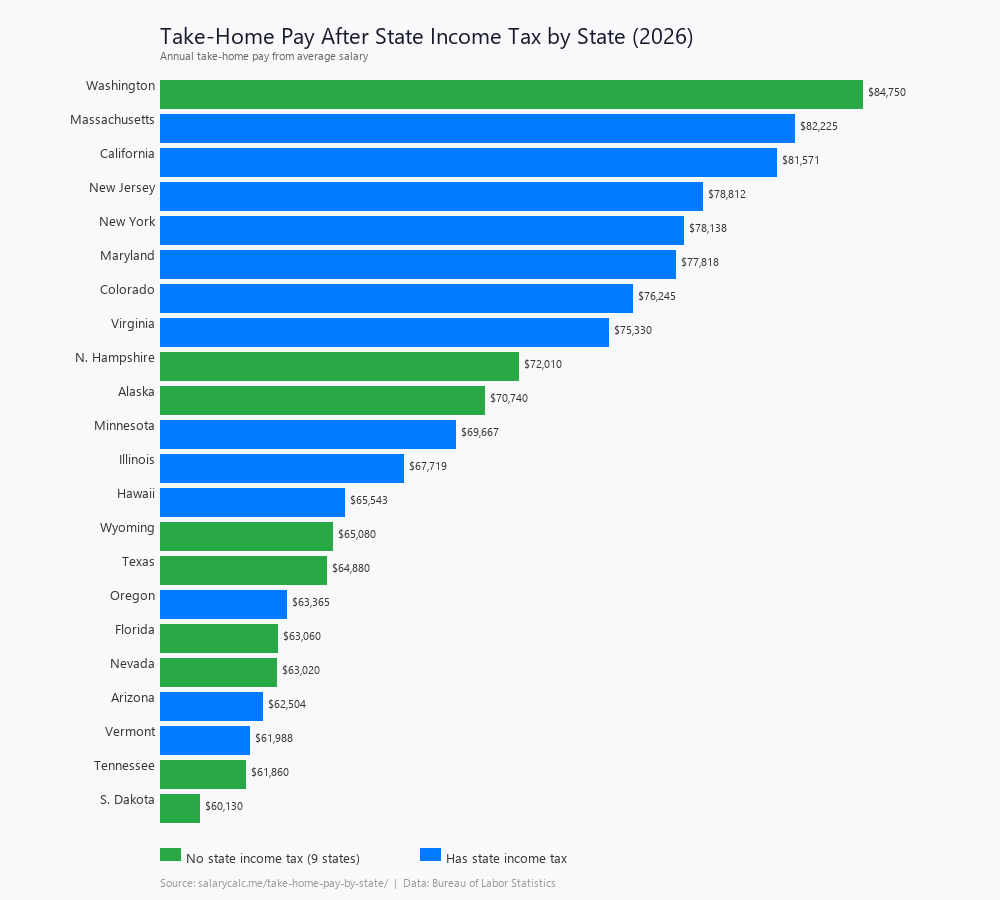
Looking at your take-home pay by state is essential when comparing job offers or planning a move. Your gross salary is only half the story — what really matters is your take-home pay, the amount you actually keep after federal and state income taxes. While federal tax brackets are the same nationwide, state income tax rates vary dramatically, from 0% in states like Texas and Florida to over 13% in California. This guide breaks down the average salary in every state and shows how state taxes affect your actual take-home pay.
Why Take-Home Pay Matters More Than Gross Salary
Your gross annual salary is the number on your offer letter, but your take-home pay is what actually funds your lifestyle. State income tax is one of the biggest variable deductions between states. For example, if you earn the national average salary of $65,470, living in Texas (0% state tax) means you keep thousands more per year than living in California (up to 13.3% top marginal rate on high earners). Here is how state taxes impact your real earnings.
Take-Home Pay After State Income Tax by State (2026)
The table below shows the average annual salary for each state, the effective state income tax rate for a median earner, estimated state tax paid, and the resulting take-home pay. States with no state income tax are highlighted — they offer a significant advantage for your bottom line.
States with No Income Tax — Maximum Take-Home Pay
Nine states have no state income tax: Alaska, Florida, Nevada, New Hampshire, South Dakota, Tennessee, Texas, Washington, and Wyoming. Residents in these states keep 100% of their earnings from state income tax — a significant advantage. For high earners, this can mean tens of thousands of dollars in extra take-home pay each year compared to high-tax states like California or New York. However, many of these states make up for the lack of income tax with higher sales taxes or property taxes, so consider the total cost of living when making a move.
How to Calculate Your Exact Take-Home Pay
Your specific take-home pay depends on your exact salary, filing status, deductions, and credits. Use our free 💰 Salary Calculator to calculate your exact hourly, weekly, monthly, and annual take-home pay based on your specific situation. It accounts for federal taxes, state taxes, FICA, and more.
Also check out these related guides:
📊 Average Salary by State 2026: Complete Guide
💰 State Income Tax Rates 2026: Complete Guide
🏠 Cost of Living by State 2026
📈 Federal Income Tax Brackets 2026
High-Tax vs. Low-Tax States: How Much Difference Does It Make?
The difference in take-home pay between high-tax and no-tax states is staggering. Consider a software engineer earning $120,000 per year. In Texas (0% state tax), their take-home pay after state taxes is $120,000. In California, with a top marginal state rate of 13.3% applied to high earners, the same worker could pay over $12,000 in state income taxes — reducing their take-home pay to roughly $107,800. Thats over $1,000 per month in extra state taxes. However, its important to remember that California offers higher average salaries in tech hubs like Silicon Valley, so the higher gross pay may offset the tax burden.
Federal Taxes vs. State Taxes: Whats the Difference?
Federal income tax brackets apply uniformly across the United States, regardless of which state you live in. In 2026, the federal tax brackets range from 10% to 37%. Your state of residence does not change your federal tax liability. However, state income taxes are completely separate. Some states impose a flat tax rate, others use progressive brackets, and nine states have no income tax at all. When calculating your true take-home pay, you must account for both federal and state income taxes, plus FICA (Social Security and Medicare) taxes, which total 7.65% for employees.
How to Use the Take-Home Pay Calculator
Our free Salary Calculator makes it easy to calculate your exact take-home pay for any state. Simply enter your annual salary, select your filing status, and choose your state. The calculator automatically applies the correct federal tax brackets, state income tax rates, and FICA taxes to show you your true take-home pay. You can also toggle between hourly, weekly, bi-weekly, monthly, and annual views. Try it now to see how much you actually keep after all taxes.
Take-Home Pay Comparison: $50k, $75k, $100k by State
Here is how take-home pay compares across different salary levels and states. For a $50,000 salary: in Texas you keep $50,000 before federal tax, in New York you pay roughly $2,250 in state tax ($47,750), and in California you pay about $1,000 ($49,000). For $75,000: Texas keeps all $75,000, New York takes ~$3,375 ($71,625), and California takes ~$2,250 ($72,750). For $100,000: in Texas you keep $100,000, in New York state tax is ~$5,500 ($94,500), and in California its ~$4,000 ($96,000). For high earners at $200,000+: California can take over $15,000 in state income tax, while Texas takes nothing. Use our calculator to get your precise numbers.
Frequently Asked Questions About Take-Home Pay
What is take-home pay? Take-home pay is the amount of money you actually receive after all deductions, including federal and state income taxes, Social Security, Medicare, and any other withholdings. It is your net income, not your gross salary.
Which states have no income tax? Nine states have no state income tax: Alaska, Florida, Nevada, New Hampshire, South Dakota, Tennessee, Texas, Washington, and Wyoming. Note that New Hampshire taxes interest and dividends but not wages.
How does state tax affect my salary? State income tax directly reduces your take-home pay. Depending on your state, you could lose anywhere from 0% to over 13% of your income to state taxes. This is why comparing job offers across states requires looking at take-home pay, not just the salary number.
How do I calculate my take-home pay? Use our free Salary Calculator. Enter your salary, select your state, and it automatically calculates your take-home pay after all taxes and deductions.
Is state income tax deductible on federal taxes? Since the 2018 tax reform (TCJA), state and local tax (SALT) deductions are capped at $10,000 per year for federal itemized deductions. This means most taxpayers take the standard deduction instead, making state taxes not federally deductible for most people.